Data Science and Business Analytics Approaches to Financial Wellbeing: Modeling Consumer Habits and Identifying At-Risk Individuals in Financial Services
Published 2023-12-04
Keywords
- Analytics,
- Consumer Behavior,
- Ethical AI,
- Financial Vulnerability,
- Machine Learning
- Risk Management,
- Transaction Data ...More
How to Cite
Abstract
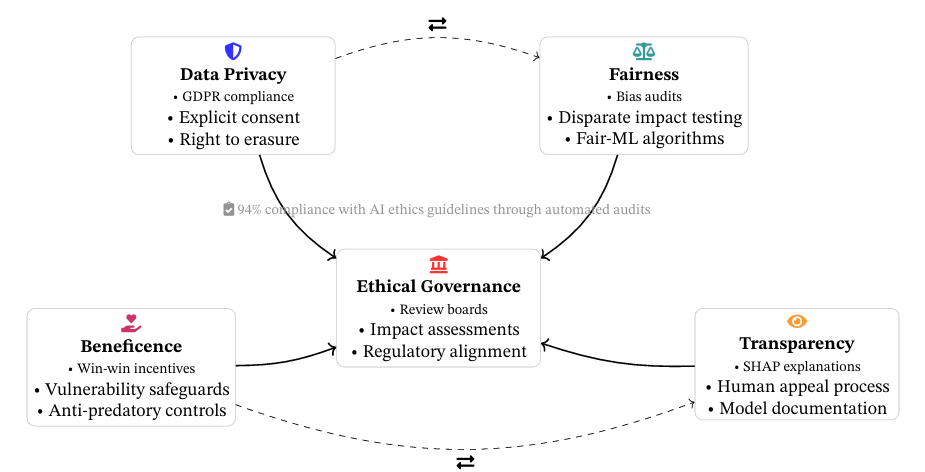
Banks and other financial institutions are increasingly using data science and business analytics to support consumer financial wellness through behavior modeling and targeting potential financial distress. In particular, this study discusses three significant areas: consumer financial behavior modeling from transaction history and digital footprints, application of analytics to population segmentation and exposure to finance, and the operational and ethical foundation for applying these solutions responsibly. This article gives a thorough explanation of how consumer expenditure behavior and high-volume transactional data can be used to establish financial habits. It describes methods of consumer population segmentation and financial vulnerability assessment with advanced machine learning models and real-time data streams to identify early warning signs of personal financial risk. One of the key themes is risk management by consumers with an emphasis on using explainable artificial intelligence (AI) to make risk assessment transparent and equitable. Discussion combines psychological and contextual information with historical financial information to create stronger consumer profiles, acknowledging that attitudes, life events, and personal circumstances have an effect on financial health. Ethical aspects are explored in detail, including ethical deployment models for such technologies that protect privacy, avoid bias, and comply with international regulatory standards. Approaches to deploying the application of real-time analytics and explainable models are also covered, with focus on integration and scalability across multiple markets. Through integration of critical algorithmic methods, conceptual models, and international case studies, the paper explains how data-based intelligence can improves financial services and deliver consumer financial stability and resilience.